Should Your Child Change the Sheets After Wetting the Bed?
If your child wets the bed, should they help change the sheets?
The short answer is that children can gradually help with age-appropriate parts of the clean-up, but changing wet sheets should never be treated as a consequence of bedwetting.
Your child’s age and willingness to help both matter. It is also helpful to separate what happens during the night from what your child might help with the following morning, so their sleep is not disrupted more than necessary.
Understanding Bedwetting
edwetting, also called nocturnal enuresis, is common in children and usually happens while they are asleep. It is not something a child does deliberately.
Several factors can cause or contribute to bedwetting, including:
Should Children Change Wet Sheets After Bedwetting?
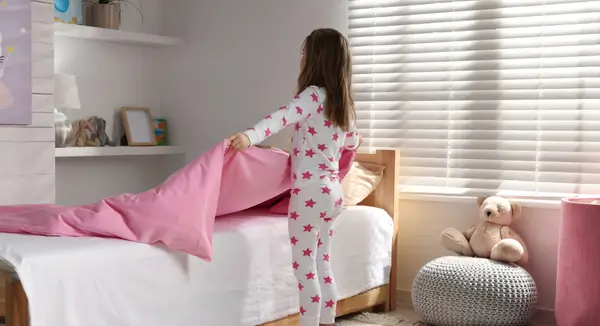
There is no single answer that will suit every family. An older child may be able to remove a wet bed mat, put wet clothing in the laundry or help remake the bed in the morning. A younger child may simply need to wake a parent for help.
During the night, the priority is usually to get everyone comfortable and back to sleep. If your child is awake, they may be able to help with a simple task, but a full bed change can usually wait until morning.
Why Involve Your Child at All?
Age-appropriate involvement can help children learn how to manage some of the practical aspects of wet nights, while also making the morning clean-up a little easier for parents.
It can also teach an older child what to do if they wake during the night or are away from home, giving them more privacy and confidence in managing a wet night.
NICE guidance includes helping to change the sheets as an example of a behaviour that can be positively rewarded, while also making it clear that bedwetting is not the child’s fault and that punishment should not be used.
Reasons Not to Expect Your Child to Change the Bed at Night
It Disrupts Sleep
Changing the whole bed in the middle of the night can wake a child fully and make it much harder for them to get back to sleep. Sleep is important for children’s mood, learning, behaviour and development, so it makes sense to keep night-time clean-up as quick and simple as possible.
A 2011 study published in the scientific journal Sleep found that children with nocturnal enuresis had more disrupted sleep and greater daytime sleepiness than children without bedwetting. Around half of the night-time awakenings recorded in the study were linked either to the bedwetting itself or attempts to manage or prevent it.
If your child wets more than once during the night, or is very sleepy and groggy when they wake, keep the clean-up as simple as possible.
It Can Feel Like Punishment
Even when you do not mean it that way, a child may hear “you need to change the sheets” as “you wet the bed, so now you have to clean it up.” Bedwetting isn’t something a child chooses to do. Helping with clean-up should feel like part of a normal practical routine, not a consequence of wetting the bed.
Research has also found poorer outcomes among children who are punished for bedwetting. A study of children aged 7-13 with bedwetting found that those who were punished for wet nights had more frequent bedwetting, greater depressive symptoms and poorer quality of life than those who were not punished.
Night-Time Help Versus Morning Involvement
It can be useful to have two different approaches.
During the night, focus on:
- Getting your child dry, comfortable and warm
- Replacing a wet bed mat if needed
- Keeping lights and conversation to a minimum
- Helping everyone return to sleep
In the morning, your child might:
- Take wet PJs to the laundry
- Help remove the bedwetting mat
- Bring clean bedding to the room
- Help remake the bed
What If Your Child Does Not Want to Help?
Some children may be happy to help with wet bedding, while others may resist it. Sometimes that is simply because they do not want to do a chore. For other children, dealing with wet bedding may feel embarrassing or very personal.
If your child does not want to help, I would not turn changing the bed into a battle. If you feel helping is important, perhaps start with one small morning task and keep it low-key. For example, giving them a choice can work well: “Would you rather take your wet pyjamas to the laundry or help me put the clean bed mat on?”
Ultimately, how much they help should depend on their age, how comfortable they feel and what they can reasonably manage. As they get older, you can gradually build from there.
What If You Do Not Want to Wake Your Child?
If your child has wet the bed but is still asleep, it’s okay to leave them sleeping if you’d prefer not to wake them. This may help protect their sleep and give them the chance to learn to wake up when they need the toilet.
Keep an eye on the situation over time, though, as repeated wetness can sometimes lead to a rash.
Please note that it’s generally not recommended to wake a child to pee in the hope of preventing a wet bed, as this can have its own drawbacks. See Should You Wake Your Child to Pee at Night?
How to Make Wet Beds Easier to Manage
Protect the Mattress
Use a full-coverage waterproof mattress protector to stop urine reaching the mattress. Check the protector regularly for worn areas, damaged seams or cracks in the waterproof backing. Even a small damaged section can allow moisture to reach the mattress. If urine has reached the mattress, follow these steps for how to clean and dry a mattress after bedwetting.
Use a Waterproof Bedwetting Mat
A washable bedwetting mat—also known as a bed pad, bed protector, Kylie sheet, incontinence pad or Bed Mate—sits over the fitted sheet and often has wings that tuck into the sides of the bed to stop it from moving. If it becomes wet, you can remove it without stripping the entire bed. This can make night-time changes much quicker. In fact, I suggest placing two bedwetting mats on the bed, one on top of the other, so a dry layer is ready underneath. Explore bedwetting mat options and suppliers.
Keep Clean Supplies Nearby
Prepare a small night-time clean-up kit containing:
- Clean PJs
- A spare bedwetting mat
- A clean washer or wet wipes
- A towel
- A waterproof bag or laundry bag for wet items
Keeping everything nearby reduces noise, movement and time awake.
Make the Routine Simple
Let your child know what will happen if they wake in a wet bed. You might say: “If you wake up wet, call me. We’ll change your PJs and bed mat and help you get back to sleep.” This gives your child a clear plan without making the clean-up feel like a major event.
The Bottom Line
Children can gradually help with age-appropriate parts of bedwetting clean-up, particularly in the morning. But changing wet sheets should never feel like a punishment for something they cannot control.
During the night, focus on getting your child dry, comfortable and back to sleep. Waterproof mattress protection, removable bedwetting mats and clean PJs kept nearby can make wet nights much easier to manage.
Making wet nights easier can help in the short term. However, bedwetting can often be improved when you look at possible contributing factors and help your child work towards dry nights.
Looking for Help to Stop Bedwetting?
If your child is between 5 and 12 and still wets the bed, the Stay Dry at Night Bedwetting Program helps you look beyond managing wet beds and explore possible contributing factors, with practical information, a structured week-by-week plan and three beautiful bedtime recordings designed to help build brain and bladder communication.
Learn more about the Stay Dry at Night Bedwetting Program.
Has your child ever helped with wet bedding? What has worked best for your family? You are welcome to share your experience in the comments.
References
Cohen-Zrubavel V, Kushnir B, Kushnir J, Sadeh A. Sleep and sleepiness in children with nocturnal enuresis. Sleep. 2011;34(2):191-194. doi:10.1093/sleep/34.2.191.
Al-Zaben FN, Sehlo MG. Punishment for bedwetting is associated with child depression and reduced quality of life. Child Abuse & Neglect. 2015;43:22-29. doi:10.1016/j.chiabu.2014.11.007.
National Institute for Health and Care Excellence (NICE). Bedwetting in under 19s (CG111). 2010, updated 2024. https://www.nice.org.uk/guidance/cg111
Share this post!